
Current Tampa Marriage Green Card Processing Time: How Long Is Adjustment of Status Taking in 2026?
Last updated: July 25, 2026
How long does it currently take to obtain a marriage-based green card through the Tampa USCIS Field Office?
According to the official USCIS Case Processing Times tool, when you select:
Form: I-485, Application to Register Permanent Residence or Adjust Status
Form category: Family-based adjustment applications
Field office: Tampa, Florida
USCIS currently displays:
80% of cases are completed within 14.5 months.
That is the official USCIS statistic. It does not mean every Tampa marriage green card case currently takes 14.5 months; in fact, it means most cases are processed in less time than 14.5 months. It also does not mean a new case filed today should be approved exactly 14.5 months from now.
The number is a backward-looking measurement of recently completed family-based I-485 cases. It is not an average, a guaranteed timeline, or a Tampa marriage-interview scheduling estimate.
What Does the USCIS 14.5-Month Figure Actually Mean?
USCIS explains that its displayed processing time is the amount of time it took the agency to complete 80% of adjudicated cases during the previous six months.
For purposes of that calculation, processing time runs from the date USCIS receives an application until the date USCIS completes it by approving or denying it.
USCIS also states that it generally updates the processing-time website monthly and that the displayed information is based on data approximately one month old. The number therefore does not provide a real-time picture of every case presently pending at the Tampa Field Office. You can read USCIS’s full explanation on its More Information About Case Processing Times page.
In practical terms, the current figure means:
Of the family-based I-485 applications included in the Tampa Field Office’s recently completed cases, USCIS completed 80% within 14.5 months of receipt.
It does not mean:
The average Tampa case takes 14.5 months;
Every Tampa case will be completed within 14.5 months;
A newly filed case will take exactly 14.5 months;
USCIS is currently working only on cases filed 14.5 months ago;
A marriage interview will be scheduled within 14.5 months; or
A case automatically becomes eligible for a USCIS inquiry after 14.5 months.
Some cases represented in the USCIS data were completed considerably sooner. Other cases took longer.
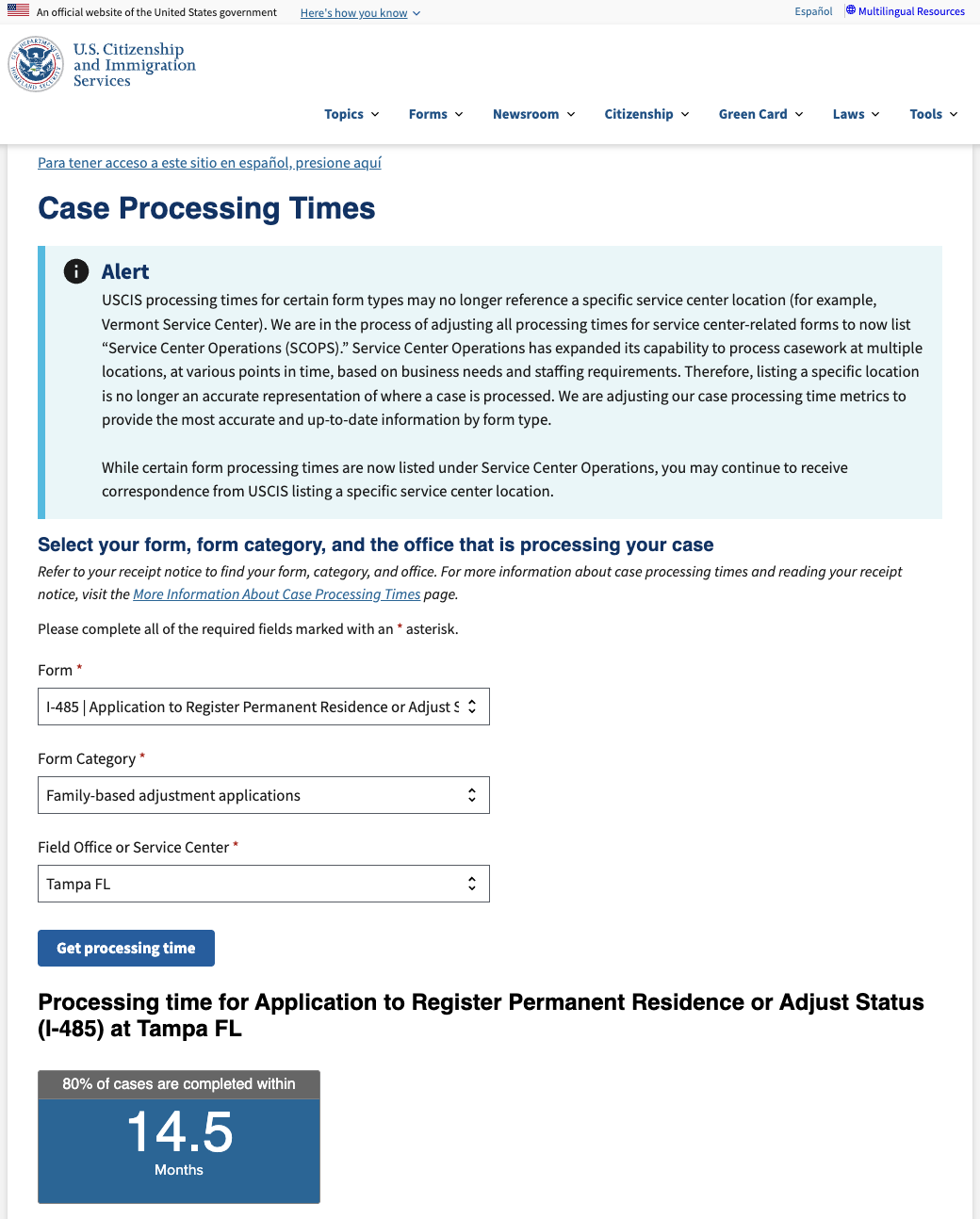
Screenshot of egov.uscis.gov/processing-times taken on July 25, 2026.
Is 14.5 Months a Marriage-Specific Processing Time?
No.
USCIS publishes the Tampa figure for the broader category of family-based adjustment applications. USCIS does not currently publish a separate Tampa processing-time statistic limited exclusively to spouses applying for green cards through marriage.
Marriage-based adjustment applications are included within the family-based category, along with other qualifying family-based I-485 applications.
The 14.5-month figure is therefore the closest official Tampa-specific benchmark for someone pursuing a marriage-based green card through adjustment of status. It should not be described as an average processing time limited only to marriage cases.
Is 14.5 Months the Average Tampa Processing Time?
No.
USCIS does not describe the displayed figure as either an average or a median. It is the time within which USCIS completed 80% of the applicable cases adjudicated during the relevant six-month measurement period.
Those measurements are different:
An average adds all processing times together and divides the total by the number of cases.
A median identifies the middle processing time.
The USCIS figure identifies the point by which 80% of the measured cases had been completed.
Calling 14.5 months the “average Tampa marriage green card processing time” would therefore be inaccurate.
Does the 14.5-Month Figure Predict When My Tampa Interview Will Be Scheduled?
No.
USCIS does not publish a separate Tampa statistic showing the time between filing Form I-485 and receiving a marriage interview notice.
The 14.5-month figure measures the entire period between USCIS receiving Form I-485 and approving or denying it. It does not isolate any individual step within that process.
For example, the statistic does not separately measure:
Filing to biometrics;
Filing to interview notice;
Filing to the actual interview;
Interview to approval;
Interview to Request for Evidence; or
Interview to denial.
Two cases that are both completed within 14.5 months may follow very different timelines. One couple might receive an interview notice relatively early but wait months for a final decision. Another couple might wait longer for the interview but receive an approval shortly afterward.
USCIS may also waive an adjustment-of-status interview when it determines that an interview is unnecessary. Couples should nevertheless prepare their initial filing as though USCIS may require them to appear for an interview. USCIS explains its adjustment interview procedures in the USCIS Policy Manual’s adjustment-of-status interview guidance.
Which Application Does the 14.5-Month Tampa Figure Cover?
The figure applies specifically to:
Form I-485, Application to Register Permanent Residence or Adjust Status, in the family-based adjustment category.
It does not provide the processing time for every form that may be filed as part of a marriage green card package.
A marriage-based adjustment filing may include:
Form I-130, Petition for Alien Relative;
Form I-130A, Supplemental Information for Spouse Beneficiary;
Form I-485, Application to Register Permanent Residence or Adjust Status;
Form I-864, Affidavit of Support;
Form I-693, Report of Immigration Medical Examination and Vaccination Record;
Form I-765, Application for Employment Authorization; and
Form I-131, Application for Travel Documents, Parole Documents, and Arrival/Departure Records.
The Tampa 14.5-month figure applies only to the family-based I-485 measurement.
What If Forms I-130 and I-485 Were Filed Together?
USCIS permits certain applicants to file the immigrant petition and adjustment application together through a procedure known as concurrent filing.
USCIS’s processing-time FAQs state that when Form I-485 was filed together with Form I-130, applicants should refer to the processing time for Form I-485.
That makes the Tampa family-based I-485 figure the relevant published benchmark for a concurrently filed Tampa adjustment case.
It does not mean that USCIS has published a separate 14.5-month Tampa processing time for Form I-130.
USCIS specifically states that it does not currently publish field-office processing times for standalone I-130 petitions transferred to a field office for an interview.
A standalone I-130 filed for a spouse who will complete consular processing outside the United States does not follow the Tampa Field Office’s family-based I-485 timeline.
Does the 14.5-Month Figure Include the Work Permit or Travel Document?
No.
A pending marriage-based adjustment applicant may separately apply for a work permit using Form I-765 and advance parole using Form I-131.
Those applications have their own receipt numbers and processing timelines. The Tampa family-based I-485 figure does not tell an applicant when USCIS will approve either application.
This means the applications may move independently:
USCIS may approve the work permit before deciding the green card application;
USCIS may approve the green card before deciding the pending work-permit application;
The I-765 and I-131 may be decided at different times; or
The I-485 may remain pending after one or both related applications have been approved.
Applicants should track each receipt number separately through USCIS Case Status Online.
Why Does My Receipt Notice Say National Benefits Center Instead of Tampa?
Many family-based I-485 receipt notices identify the National Benefits Center, commonly called the NBC.
USCIS instructs family-based I-485 applicants whose listed office is the National Benefits Center to check the processing time for their local field office. For applicants whose local field office is Tampa, that generally means selecting Tampa in the processing-time tool.
If USCIS transfers the case to another office, USCIS instructs the applicant to use the processing time for the new office. Applicants who are unsure which local office applies can use the USCIS Field Office Locator.
The address printed on an individual USCIS notice still controls. Applicants should follow the instructions on their receipt notice, biometrics notice, Request for Evidence, or interview notice rather than assuming every appointment or submission takes place at the Tampa Field Office.
Why Can Two Tampa Marriage Green Card Cases Take Different Amounts of Time?
The USCIS figure combines many completed applications into a single statistical measurement. It cannot predict how the facts of one particular case will affect its timeline.
USCIS identifies several factors that may affect processing times, including:
The number of applications received;
USCIS workload and staffing allocations;
The complexity of an individual case;
The time an applicant takes to respond to a request;
Missed or rescheduled appointments;
Policy changes; and
Operational changes.
USCIS also confirms that its processing-time measurement includes time spent waiting for biometrics, responding to Requests for Evidence, and rescheduling interviews.
Case-specific issues that may require additional review include:
Missing forms, signatures, or supporting documents;
Insufficient financial sponsorship evidence;
A Request for Evidence;
A Notice of Intent to Deny;
Limited evidence of a bona fide marriage;
Different residential addresses for the spouses;
Prior marriage petitions;
Previous visa or immigration applications;
Unauthorized employment;
Overstays or other status violations;
Arrests or criminal history;
Possible fraud or misrepresentation;
Prior removal proceedings;
A previous removal order;
Inconsistent information in government records;
Changes in the marriage after filing; or
Additional review following the interview.
USCIS’s May 2026 adjustment-of-status policy memorandum may also result in closer review of discretionary factors in cases involving immigration violations, arrests, possible fraud, or other negative history. For more information, read our related article: New USCIS Adjustment of Status Memo: Is Form I-485 Still Safe to File?
A complete application does not guarantee fast processing. An incomplete or inconsistent application can, however, create avoidable delays and risks.
Special Note for Spouses of Lawful Permanent Residents
The spouse of a U.S. citizen is generally classified as an immediate relative and is not subject to an annual immigrant-visa quota.
The spouse of a lawful permanent resident generally falls within the F2A family-preference category. Visa availability may independently affect when USCIS can approve the I-485.
USCIS states that visa-regressed I-485 applications are not included in the processing-time calculation displayed on its website. Applicants in a preference category should therefore review the current Department of State Visa Bulletin in addition to checking the Tampa processing-time figure.
A 14.5-month Tampa processing statistic does not override the requirement that an immigrant visa be available when USCIS approves a preference-category adjustment application.
Is My Case Outside Normal Processing Time After 14.5 Months?
Not automatically.
The 14.5-month figure reflects the time within which USCIS completed 80% of the measured cases. USCIS uses a different measurement to determine when someone may submit a case inquiry.
USCIS calculates the case-inquiry date using the time required to complete 93% of adjudicated cases. The inquiry date is therefore generally later than the 80% processing-time figure displayed at the top of the page.
To determine whether USCIS will accept an inquiry:
Open the USCIS Case Processing Times tool.
Select Form I-485.
Select “Family-based adjustment applications.”
Select “Tampa FL.”
Scroll to the case-inquiry section.
Enter the receipt date shown on the I-485 receipt notice.
Review the date or inquiry option provided by USCIS.
The tool will either provide an estimated date when an inquiry may be submitted or provide access to the inquiry process.
Applicants can also access USCIS’s online e-Request system, but USCIS may decline a processing-time inquiry submitted before the case reaches the applicable inquiry date.
How Can I Track My Tampa Marriage Green Card Case?
Each application generally has its own USCIS receipt number. Applicants should separately track the receipt numbers for the I-130, I-485, I-765, and I-131 when those forms were filed.
You can enter each receipt number into USCIS Case Status Online. A USCIS receipt number generally contains three letters followed by 10 numbers.
Online updates may include:
Case Was Received;
Biometrics Appointment Was Scheduled;
Case Is Being Actively Reviewed;
Request for Evidence Was Sent;
Response to USCIS’ Request for Evidence Was Received;
Interview Was Scheduled;
Case Was Approved; or
New Card Is Being Produced.
An online status does not always explain everything happening internally with a case. Applicants should continue monitoring their mail and USCIS online accounts for formal notices.
Should I Be Concerned If My Case Has Been Pending for Several Months?
Not necessarily.
It is common for an adjustment application to remain pending for months without a meaningful public status update. A long period without an update does not, by itself, prove that USCIS has lost the case or intends to deny it.
A legal review may nevertheless be appropriate when:
The case was filed without an attorney;
The couple does not have a complete copy of the filing;
Important evidence may have been omitted;
USCIS issued an RFE or NOID;
USCIS scheduled a Tampa interview;
The spouses currently live apart;
The marriage has materially changed since filing;
The applicant or petitioner has been arrested;
The applicant has a previous immigration application or petition;
There may be inconsistent information in prior government records;
The applicant previously used false information or documents;
The applicant has been in immigration court;
A previous marriage petition was denied or withdrawn; or
The USCIS inquiry tool permits an inquiry, but the case remains unresolved.
Applicants who do not know what USCIS has in their immigration history may benefit from obtaining and reviewing their records before submitting another filing or attending an interview. Learn more about immigration FOIA and record requests.
Can an Immigration Attorney Make USCIS Process the Case Faster?
An attorney cannot control USCIS staffing, workload, interview scheduling, or adjudication speed. No attorney can guarantee that USCIS will approve a case within 14.5 months or by any other specific date.
An attorney may still help by:
Evaluating whether the applicant qualifies for adjustment of status;
Identifying legal or factual problems before filing;
Preparing the initial marriage green card package;
Reviewing an application previously filed without counsel;
Identifying missing or inconsistent information;
Organizing updated evidence of the marriage;
Preparing both spouses for the USCIS interview;
Attending the Tampa interview;
Addressing issues that arise during the interview; and
Evaluating available options when a case has been significantly delayed.
The purpose of legal representation is not to promise faster processing by USCIS. It is to reduce avoidable mistakes, identify risks, and present the strongest accurate application supported by the facts.
Frequently Asked Questions
What is the current Tampa family-based I-485 processing-time figure?
As of July 25, 2026, the USCIS processing-time tool states that 80% of family-based I-485 applications at the Tampa Field Office were completed within 14.5 months.
Does that mean my Tampa marriage green card will take 14.5 months?
No. The number is based on recently completed cases and does not predict the exact timeline of an individual pending or newly filed application.
Is 14.5 months the average?
No. USCIS does not describe it as an average. It is the amount of time within which USCIS completed 80% of the applicable adjudicated cases during the relevant six-month period.
Will USCIS schedule my Tampa marriage interview within 14.5 months?
The published USCIS statistics do not answer that question. USCIS does not publish a separate Tampa filing-to-interview processing-time figure.
Does the figure include the I-130?
The displayed figure is for Form I-485. When Forms I-130 and I-485 are filed together, USCIS directs applicants to refer to the I-485 processing time. It is not a standalone Tampa I-130 processing time.
Does it include my work permit or advance parole?
No. Forms I-765 and I-131 are separate applications with separate processing timelines.
Can my case take longer than 14.5 months?
Yes. The displayed figure covers 80% of recently completed cases, not every case.
Can my case be approved sooner?
Yes. Most cases are completed in less than 14.5 months.
Can I submit a USCIS inquiry as soon as my case reaches 14.5 months?
Not necessarily. USCIS calculates the inquiry date using the time required to complete 93% of adjudicated cases. Enter your receipt date into the USCIS processing-time tool to determine when an inquiry is available.
How Mora Immigration Group Tampa Can Help
Mora Immigration Group Tampa assists couples applying for marriage-based adjustment of status and applicants preparing for interviews at the Tampa USCIS Field Office.
We assist with:
New marriage-based I-130 and I-485 filings;
Review of applications filed without an attorney;
Marriage evidence preparation;
Tampa adjustment-of-status interview preparation;
Attorney representation at Tampa marriage interviews;
Cases involving overstays or unauthorized employment;
Cases involving arrests or criminal history;
Review of prior immigration records; and
Delayed or complicated adjustment applications.
Learn more about our marriage green card services, green card representation, and family-based immigration services.
Call or text (813) 815-VISA, or book a free consultation online.
Official Sources and Related Resources
USCIS Resources
Mora Immigration Group Tampa Resources
Attorney advertising. This post is for general informational purposes only and does not constitute legal advice. USCIS processing times, procedures, and policies can change. Tampa-based immigration attorney Miguel Mora is licensed to practice law in Illinois and focuses on federal immigration matters. Viewing this article or contacting Mora Immigration Group Tampa does not create an attorney-client relationship.